
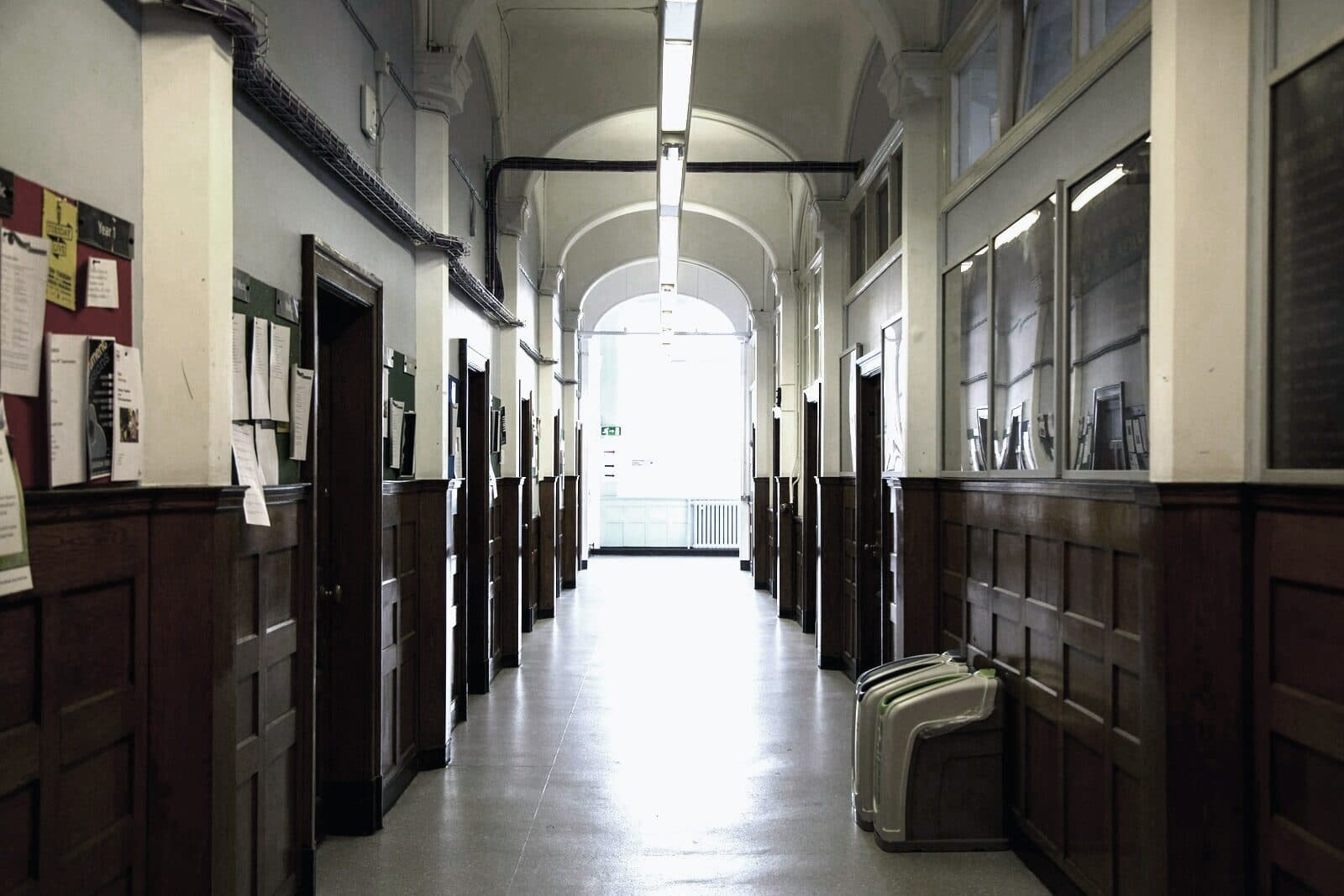
Security for Educational Institutions
A campus is a controlled population that becomes a public one twice a day. The gate has to hold without students ever thinking about it.
Educational Institutions
Consult. Investigate. Protect.
Educational security answers to parents, not only to a client. That changes what the deployment is for: knowing who is on campus, controlling the two hours a day when the boundary dissolves, and verifying every adult placed near a student.
Advisory, investigation and guarding for this sector sit under one command structure, so a gap found in an assessment becomes a revised post instruction rather than a message to another vendor.
Where this sector actually loses ground.
Campus risk concentrates at the boundary, in residential blocks, and in the hours when students are in transit.
Campus access and outsider entry
Multiple gates, a large daily population, visitors who are genuinely expected and outsiders who are not, and a boundary that in most institutions is a wall with several informal openings in it. Identity discipline weakens fastest at the gates used by staff and vendors rather than at the main entrance.
Hostel and dormitory discipline
Residential blocks operate to different hours and rules from the academic campus. Late entry and exit, unauthorised visitors, substance and contraband entry, and movement between men's and women's blocks all require a documented register and consistent enforcement rather than the discretion of whoever is on the gate.
Ragging, harassment and safeguarding
The institution has statutory and moral safeguarding obligations, and security is frequently the first adult presence to notice that something is wrong. Personnel need to know what to report, to whom, and how quickly — and must never be placed in a position of handling a student welfare matter themselves.
Examination material integrity
Question papers, answer scripts and evaluation rooms need custody control, restricted access and documented movement. Examination days also bring crowds, external candidates and invigilators onto campus at once, in a period when the normal identity discipline is under the most strain.
Transport bay and parent gate crush
Opening and closing time is the highest-risk period of the campus day: buses manoeuvring among children on foot, parents parking on the approach road, and an authorised-release problem — knowing which adult may collect which child — dressed up as a traffic problem.
Posts, supervision, shifts and the report that follows.
A campus deployment is built around the school or college clock, weighted heavily toward arrival and dispersal, with residential blocks treated as a separate command inside the same plan.
Post structure
Main gate with identity discipline for students, staff and visitors, staff and service gates held to the same standard, hostel gate posts with women security personnel on women's blocks, transport-bay marshalling at arrival and dispersal, academic-block and laboratory cover after hours, and night patrolling of the campus boundary and residential areas.
Supervision layer
A site supervisor is accountable to the administrator, principal or chief warden, with hostel duties supervised separately because they run to a different clock. Personnel conduct around students is a reviewed item at every check, not only at induction.
Shift pattern and academic calendar
Strength is concentrated at arrival, dispersal and hostel entry hours rather than spread evenly. The plan carries agreed reinforcement for examination periods, admissions, sports days, cultural events and results announcements, and a reduced pattern for vacations when the campus is largely empty but the property is not.
Escalation and reporting
A written escalation path covers a missing or absconding student, an outsider on campus, a medical emergency, a safeguarding disclosure and a parent dispute, naming the institutional authority informed at each stage. Personnel report and hand over — they do not adjudicate. Your administration receives incident, hostel-register and visitor reporting on an agreed cycle.
Three disciplines, read against this sector.
Most engagements in this sector begin with one of the three and widen once the picture is clear. Open a discipline for the full scope of what it delivers.
Consult
We assess a campus as a boundary that must be permeable at fixed times and closed the rest of the day, and design the controls around that rhythm rather than around a static perimeter.
- Gate, transport-bay and dispersal design, including authorised-release procedure for young children
- Hostel movement, late-entry and visitor procedure written for consistent enforcement
- Camera and lighting priorities set for corridors, boundaries and approaches with student privacy respected
Investigate
Enquiries on a campus involve minors, reputations and parents, so they are conducted with restraint and reported to the institution rather than discussed on it.
- Background verification of teaching, non-teaching, hostel, canteen and transport staff
- Verification of drivers and attendants engaged through transport contractors
- Discreet enquiry into theft, examination-material compromise and staff misconduct
Protect
Every person we place on an educational campus is verified before deployment and inducted specifically on conduct around students — approachable, calm, and clear that welfare matters are reported upward immediately.
- Gate, hostel, transport-bay and night patrol posts staffed to the academic clock
- Women security personnel for women's hostels, frisking and female-student duties
- Induction on safeguarding reporting lines, emergency procedure and institutional escalation
What you should be able to see.
A deployment is only worth what it makes visible. These are the measures we expect to be judged on in this sector.
A campus population you can state
Identity discipline at every gate, including staff and service entrances, means the institution knows who is inside during the hours it matters.
Dispersal that is managed, not survived
Transport bays and parent gates are marshalled to a plan, separating pedestrian children from moving vehicles at the most dangerous fifteen minutes of the day.
Hostels run to a written rule
Entry, exit, late returns and visitors are recorded consistently, so wardens are working from a register rather than from recollection.
Verified adults around students
Security personnel, and where you ask for it your wider staff and transport crews, are antecedent-verified with records the institution can produce to parents or an inspecting authority.
The questions that come up first.
We do not want an intimidating security presence around children. How do you handle that?
By making the presence deliberately calm. Personnel for educational campuses are selected on temperament, inducted on how to speak to students and parents, and posted so that visible strength sits at the boundary and the transport bay while the interior is covered by patrolling rather than static posts. We do not propose armed deployment on an educational campus unless an institution has a specific, justified requirement and the statutory permissions to match.
Our transport bay at dispersal time is chaotic and genuinely unsafe. What changes?
Dispersal is treated as a planned operation rather than a rush. That normally means marshalled bus bays with a fixed sequence, separated pedestrian routes for children on foot, a controlled parent-collection point kept off the bus lane, and personnel who know the authorised-release rule for younger children. Most of the improvement comes from layout and sequencing, which we would assess before recommending more people.
How do you protect examination material?
Through custody control rather than presence. Storage is a restricted area with a controlled key, access is limited to named officials and recorded on every opening, movement of material between strongroom, examination hall and evaluation room is escorted and logged, and examination-day access to the campus is tightened for external candidates and invigilators. Where a compromise is suspected, that is an investigation, and it should be run as one.
What is your personnel's role if a student discloses something serious to them?
To listen, to keep the student safe, and to report it immediately to the named institutional authority — nothing more. Personnel are inducted explicitly that they do not question a student, do not investigate, and do not discuss the matter with anyone other than the designated authority. The reporting line is written into the post instruction and confirmed with your administration before deployment.
Other Sectors


Security built for Educational Institutions.
Tell us the location, the working pattern and what you believe is going wrong. That conversation usually settles whether you need an assessment, an enquiry or a deployment — and it costs nothing.
Security. Intelligence. Assurance. — Pan India Presence